
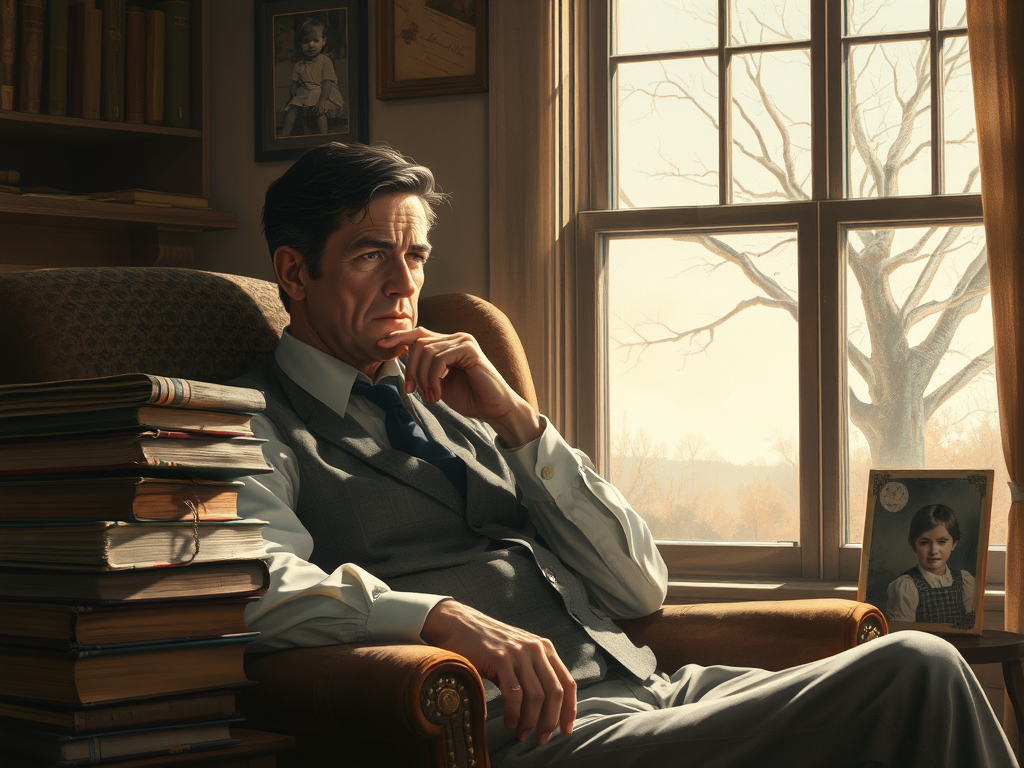
Before I ever cracked open the book, I watched the movie.
I was a little girl, sitting in my grandmother’s house, cycling through the same stack of VHS tapes: To Kill a Mockingbird, Arsenic and Old Lace, and Moonwalker. I must’ve watched them a hundred times, maybe more. But Mockingbird stood out—because of Atticus.
Atticus Finch was, to me, what a father should be: calm, capable, reflective. He didn’t shout. He didn’t rush. He just was. The actor played him with such quiet strength, it felt like he walked right out of real life. And in many ways, he reminded me of my grandfather.
Granddaddy was ex-military, and he moved through the house like clockwork. Up at 5 a.m., emptying every trash can in the house—upstairs and down. Beds made with corners folded so tight you could bounce a coin. Linen closet looking like a department store display. That was him. So of course when I saw Atticus Finch, I thought: that’s what a man is. That’s what a father is.
But then—I read the book. Two years ago.
And suddenly, it wasn’t so simple anymore.
The thickness of racism in the story—the stuff the movie couldn’t fully capture—settled on me like a weight. Characters I once viewed fondly started to shift in the light. The nanny, for instance. In the movie, I saw her as cheerful and essential to the family. But in the book? I saw a woman caught between two worlds. A woman who didn’t fully belong in either. And that realization broke something open in me.
What did Scout really understand about her? About her church? About what it meant to be a Black woman working for a white family in a deeply segregated world?
Who explained it to her?
And what about the trial? About Tom Robinson? A man condemned not because of guilt, but because he was disposable. It was easier to discard a Black man than admit a white family—broken and incestuous—had done real harm. That truth was hard to swallow. Painful. Infuriating.
And then there was Dill. His stories about his father—half-hopeful, half-fictional—sounded like a boy trying to survive abandonment. Jem, carrying burdens bigger than he knew what to do with. The Radley family, misunderstood and ghosted by a community that couldn’t be bothered to ask questions. The fire. The neighbor with the addiction (was it morphine? I think so). The garden.
All of it was heavy.
But somehow, in between the pain, there was also joy. Wonder. Real kids being kids. Running around. Playing games. Laughing. Even in the darkness, there were these bursts of light.
And that’s why I don’t think I can sum this book up as just “raising kids in a broken world.”
No.
To Kill a Mockingbird is a painful reminder of how broken the world really is.
But also—how kids keep growing anyway. How innocence and injustice can exist side by side. How a little girl with muddy knees and questions too big for her age can still find joy, even as the world around her quietly falls apart.
And as for Atticus? I’m still not sure.
Was he the moral compass? Or the man who didn’t speak up enough?
Maybe he was both.
Just like the rest of us.
If this post spoke to you…
Share it with someone who might need it, too. Whether it’s a quiet encouragement or a new way of seeing things, these reflections are meant to be passed along.

|
Martina Griffin is a Catholic convert, writer, wife, and mother of four. She writes about faith, motherhood, beauty, books, and the quiet ache of transformation. A lover of popcorn, deep questions, and old classics, she shares her heart at Big Bowl of Popcorn—one post at a time. Instagram | Facebook | Email Me |
Don’t Miss a Post
Stories of faith, motherhood, and becoming—delivered straight to your inbox.
Leave a Reply